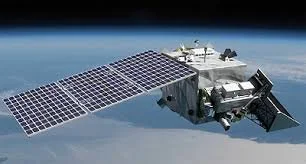
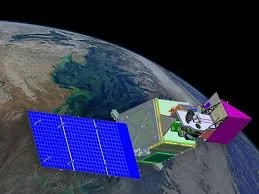
PACE OCEAN Satellite
The engine behind the mission: OCI
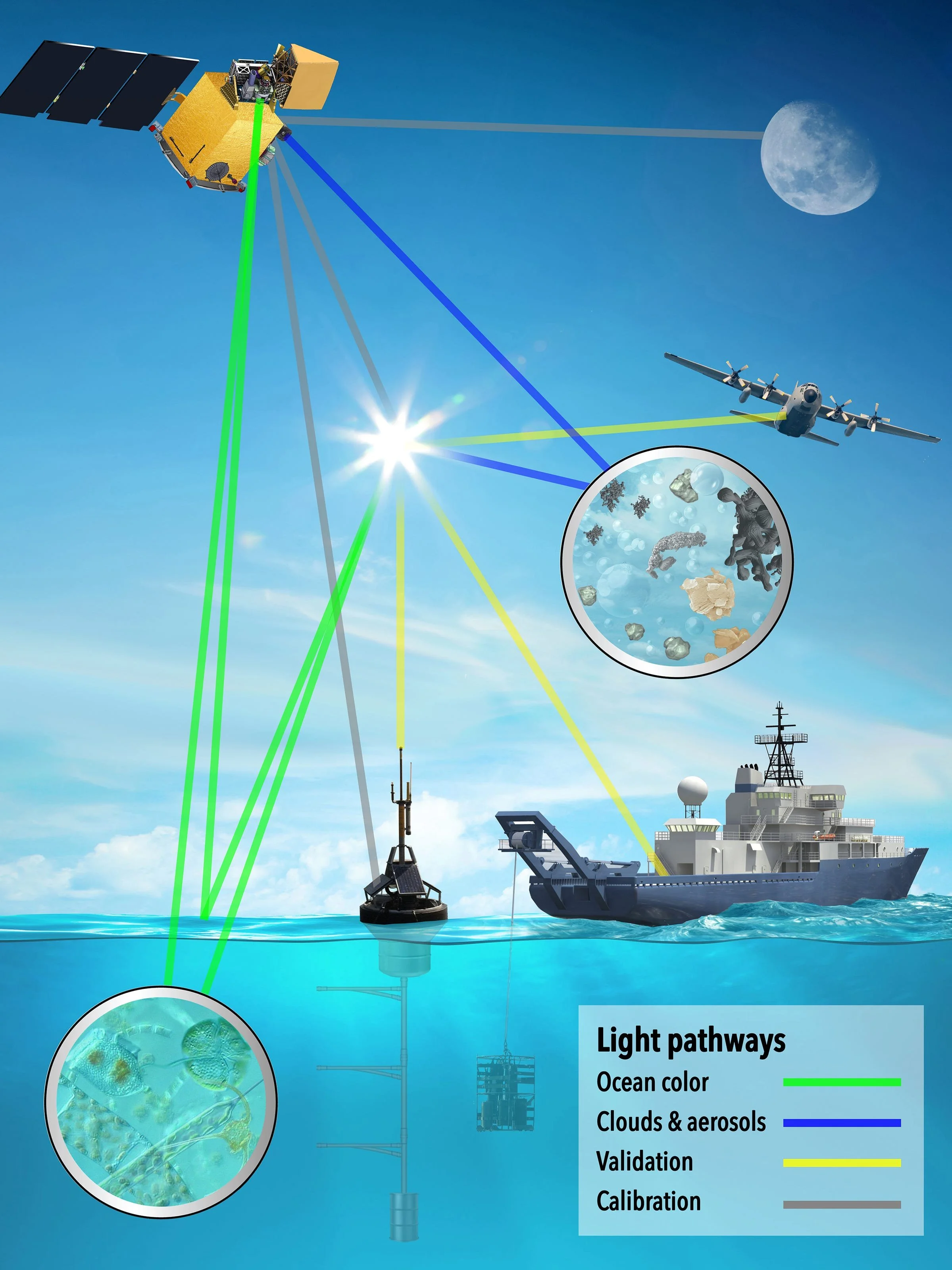
PACE’s primary sensor, the Ocean Color Instrument (OCI), is a highly advanced optical spectrometer that measures properties of light over portions of the electromagnetic spectrum. It enables continuous measurement of light at finer wavelength resolution than previous NASA satellite sensors, extending key ocean color data records for climate studies.
Ocean color is driven by the interaction of sunlight with substances and particles in seawater, especially chlorophyll, the green pigment found in most phytoplankton species. By monitoring global phytoplankton distribution and abundance with unprecedented detail, OCI helps us better understand the complex systems that drive ocean ecology.
Built at NASA Goddard Space Flight Center, OCI combines innovative engineering with precise calibration systems. It includes a cross-track rotating telescope, thermal radiators, a half-angle mirror, and solar calibration mechanisms. The instrument’s tilt helps avoid sun glint, while its single science detector design helps inhibit image striping—supporting exceptionally stable, high-quality measurements.
Why PACE matters to our research
The PACE mission is extending and expanding NASA’s long-term observations of our living planet. Its cutting-edge technology is pioneering new ways of taking Earth’s pulse for decades to come. In the Gomez Goes Lab, we use PACE observations to connect ocean biology, ocean optics, and atmospheric inputs to understand how the Earth system functions and how it is changing.
OCI features include:
Cross-track, 360° continuous rotating telescope
Two slit-grating hyperspectral spectrographs (ultraviolet to visible, and visible to near-infrared)
Fiber-coupled multiband filter spectrograph (near-infrared to shortwave-infrared)
· What we study with PACE in the Gomez Goes Lab
· Harmful algal blooms and coastal impacts
· Novel uses of PACE data will benefit our economy and society. One high-impact example is harmful algal blooms: PACE will help identify their extent and duration. In the Gomez Goes Lab, we use PACE observations to support improved monitoring of bloom development and persistence, strengthening scientific understanding that can inform public health, fisheries, and coastal decision-making.